Showing posts with label ethology. Show all posts

Tuesday, July 27, 2010

Do octopuses play?

         I was recently pointed to this article on "octopus intelligence".  I like the article (which features quotes from such cephalopod research all-stars as Roger Hanlon and Jennifer Mather,) although I am a bit let down by the brief, incomplete explanation that is given to the various "intellectual" abilities of the octopus such as "problem solving" and "play".  Both of these behaviors are difficult to define precisely, and are often understood in vertebrates by analogy to human experience.  For example, one of the criteria that is used to define play in animals (as stated in Kuba et al. 2003, a study on play-like behavior in octopuses) is that it is "spontaneous and pleasurable ('done for its own sake')".  This is one of the central features of play - that it appears to serve no other immediate purpose than to entertain or occupy the animal expressing the behavior.  I take some issue with the use of the term "play
 to describe octopus behavior, at the very least because the implications of play-like behavior in the octopus are not very well studied yet.  It's much harder to determine the motivational significance of an activity in an octopus than it is in, say, a rat.  This is because we know the brain and behavior of the rat much more thoroughly than we know those of octopuses, and since they are structurally similar to ours we can relatively easily design valid measures of motivation in rats.  In contrast to the vast (though still incomplete) neurological and behavioral description of pleasurable and aversive states in the rat that we have generated, we have only a very crude measure of the possible hedonic characteristics of an activity in the octopus; that is, we can assume that the octopus will do "pleasurable" things and will avoid aversive things, but we have little more to go on when we are talking about the motivation of an octopus.  Because of this limitation, I think that it may be too early to say for sure what processes play-like behaviors in the octopus actually represent, and so the touting of play as evidence of the impressive mental powers of the octopus also seems premature.

         Whoa, now!  Before I go making assertions like this, I should look at the research, right?  Good call.  Let's see what the vast scientific library that is the internet can teach us about the play-like behavior of octopuses.

         I'll focus on Kuba et al. (2006), a recent study that was done to examine putative play behavior in O. vulgaris.  In this study, the authors exposed octopuses to stimuli made out of Lego blocks for half an hour at a time repeatedly over a period of 7 days and scored the octopuses reactions to the objects.  The authors' scoring system is illustrated below (this if Figure 1 from the paper.)

         As you can see, level 3 (which the authors describe as "play-like") and level 4 (which the authors call "play") involve repeatedly manipulating non-food objects in complex, non-stereotyped ways for a significant amount of time.  Out of 14 (wild-caught) subjects, object manipulation that was scored at level 3 was observed in 9 subjects, and object manipulation that was scored at level 4 was observed in one subject.  There was no difference of age or hunger state in this behavior (young and old octopuses showed the same sorts of behavior, as did hungry and sated octopuses.)  Play-like behaviors tended to occur after several days of presentation of the stimulus, suggesting that this was not merely exploratory behavior, which appeared to decrease during the first few days of exposure (as the octopuses presumably got used to the presence of the stimuli in their tanks.)

         By this point, I tentatively buy the characterization of these behaviors as "play" - they don't appear to serve any purpose for the octopus, who is clearly not simply confusing the objects with food.  They are exhibited after the octopus has presumably had ample time to learn that they do not represent a threat.  The behaviors do not appear to clearly belong to any other class of behavior (except perhaps tactile exploratory behavior.)  As I said before, however, using the existence of these behaviors to argue for the intelligence of the octopus seems premature to me.  For one, the significance of these behaviors in the wild is not well understood - they must confer some survival utility, but they do not appear to be disproportionately expressed in young, rapidly developing octopuses as they are in mammalian young, and so are unlikely to contribute to neurodevelopment in the same way that play in mammals (especially social mammals) is thought to.  We know that play in social mammals (like humans, some apes, and rats) serves a variety of functions in development - to establish dominance hierarchies, to develop skills for living within social organizations, to learn hunting and food-gathering behaviors, to help develop motor coordination, etc.  We have comparatively little sense of the importance of play in the life of an octopus, and so it is hard to know what play-like behavior means in the context of octopus cognition.

         Because we know that play is very important to the cognitive function of mammals I mentioned previously (more properly, we know that disrupting play behavior causes deficits in behaviors that depend on play to develop,) we can claim that play is part of a group of behaviors that make manifest the intelligence of these animals.  Without knowing what play-like behavior does for an octopus, it's hard to say whether it implies an analogous intelligence in these animals.  It might be explained in many cases as a simple extension of exploratory behavior.  As a foraging predator, it makes sense that O. vulgaris would be served well by repeated, thorough explorations of the same object, which mobile and semi-mobile prey would presumably periodically be found on.  This behavior might be explained as part of a foraging strategy that is somewhat impervious to associative learning, and so violate the criteria that we use to classify a behavior as play all together.

         My discussion thus far has accepted the hypothesis that behavior classifiable as play occurs regularly in the octopus, and thus needs to be explained in terms of its adaptive utility to the animal.  Based on the previously summarized paper, however, clear play-like behavior in the octopus appears to be pretty rare.  On the 5th day of the experiment, when play-like behavior peaked, 444 interactions with the stimuli were observed.  Out of these, 13% qualified as level 2 (they involved manipulation beyond very basic exploration of the object with the arms,) 0.9% were scored as play-like, and a single observation (0.02% of the total observations) was scored as being definitively "play".  I think this was a well-designed study, but the results don't convince me that play (as defined by the authors) is terribly important in the lives of octopuses, and might just as well represent a rare, specific type of interaction that they have with unusual stimuli in a laboratory environment.

         I realize that I have been sort of hard on this study.  I don't want to imply that octopuses are not remarkable animals that are capable of many things one wouldn't expect from a mollusc.  I do think, however, that it pays to be very skeptical about the use of the terms "play" and "intelligence".  Both of these are concepts that we understand primarily by analogy to our experience of them as humans.  We know that social play in vertebrates is indeed play (even the scientists among us) because we know what a play fight feels like, and understand intuitively how it differs from a real fight.  We can extend this to behaviors that we see in animals (with more or less accuracy, depending on the situation.)  We know what intelligence means (or we think we do) because we have expectations of how people should function, and we can draw analogies to other vertebrates who have the same sort of behavioral flexibility and environmental demands that we do.  One might dismiss this as unscientific, but we have pretty good evidence that the neural structures that are responsible for a variety of emotions and types of behaviors are conserved in some form across species (in mammals at least.)   Thus, we can be somewhat comfortable in our understanding of the role of play in a rat's cognitive life because, at a pretty complex level of structure and function, they have essentially the same machinery in their head that we do.  It's a bit less convincing to use the same anthropomorphic logic to justify associating what looks like play behavior in an octopus with the "intelligence" that we suspect goes along with play behavior in vertebrates.  This is because the existence of analogous neural substrates and their accompanying cognitive functions (emotions, hedonic value, etc.) is not clear.  It strikes me as somewhat mistaken that we would use psychological constructs that were created to describe human behavior such as "play" and "problem-solving" to describe cephalopod behavior, though we do it even when they appear to be a poor fit to the behavior in question.

         As Jennifer Mather points out in her quote in the Boston Globe article: “We’re smart and the octopus is smart, but octopus intelligence just can’t be related to our intelligence.”  This I have to agree with.  Just because we can call a behavior something that sounds familiar (in this case, "play") doesn't mean that we've explained it, even though it might appear this way.  I think that octopuses are fascinating and astounding creatures that exhibit very interesting behaviors; I'm just not quite convinced that they play.

Thanks for reading!

ResearchBlogging.org
Kuba, M., Byrne, R., Meisel, D., & Mather, J. (2006). When do octopuses play? Effects of repeated testing, object type, age, and food deprivation on object play in Octopus vulgaris. Journal of Comparative Psychology, 120 (3), 184-190 DOI: 10.1037/0735-7036.120.3.184

M Kuba, D V Meisel, R A Byrne, U Griebel, & J A Mather (2003). Looking at Play in Octopus Vulgaris Coleoid cephalopods through time, 163-169

Tuesday, July 20, 2010

The Myth of the Humboldt Squid

I recently got a request (thanks to arvindpillai at Fins to Feet) to do a post on the shoaling and predatory behavior of Humboldt squid, Dosidicus gigas (also known as the Jumbo squid, and by those who don't know any better, the giant squid.)  I decided that this would be a good thing to do, because I hadn't read much about the predatory behavior of D. gigas.  So I spent a week searching the literature for scientific studies on Humboldt squid predatory behavior, and guess what?  I still haven't read much about it!

It turns out that there is very little known about the behavior of these squid.  The paucity of our ethological knowledge of them is shocking to me, given the disproportionate attention to this species in popular media.  I've seen at least one budding cephalopod enthusiast become intrigued by stories about this species to the extent of obsession, and it's not hard to see why.  Somehow, these squid have gained a reputation as fierce predators that are so bloodthirsty as to be regularly deadly to humans.  As such, popular TV shows and news magazines have run numerous stories about them, usually finding one or two divers who have (presumably) had experience with these squids (or at least heard stories about them) to expound on just how ferocious and aggressive they are.  Invariably, some sensational quip (that is almost always unsupported by scientific literature because, well, that literature does not exist) is used to drive home just how scary these squid are:

"It has probing arms and tooth-lined tentacles, a raptor-like beak and an insatiable craving for flesh -- any kind of flesh, even that of humans," says Pete Thomas in "Warning lights of the sea". 

Mike Bear, an otherwise anonymous diver from San Diego is quoted in this article as saying "I wouldn't go into the water with them for the same reason I wouldn't walk into a pride of lions on the Serengeti." 

“The Humboldt squid is a voracious predator that will eat anything it can get its tentacles on,” says Kelly Benoit-Bird, an oceanographer, quoted by Mark Floyd in this piece.

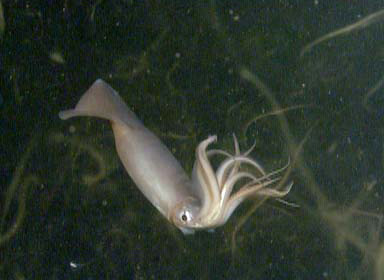
With all the hubbub, these guys must be pretty dangerous, right?  The stuff of nightmares, even!  I mean, just look at this bloodthirsty monster!


Oh wait, it's kind of cute, isn't it?

This is the myth of the Humboldt squid: that they are first and foremost dangerous, indiscriminate killing machines.  This is, frustratingly, the first (and often only) piece of information that is repeated about them in any given article.  But what's the real story?

Let's put this in perspective by considering the case of sharks, another predatory ocean-dweller that has been sensationalized as being imminently dangerous to humans (remember "Jaws"?  It was pretty silly, but a lot of people took that era's shark scares seriously.)  Fatal shark attacks on humans are documented somewhat regularly, and are discussed (albeit infrequently) in the scientific and medical literature (ie. this study on fatal shark attacks.)  I cannot find a single verifiable record of a fatal squid attack on a human in the medical literature (admittedly, I have only searched 3 online databases and Google scholar - I might be missing something.)  The closest thing I can find are fisherman's accounts in popular media of other fisherman's stories about hearing about people being killed by Humboldt squid.  Keeping in mind the D. gigas is a rather common animal, is fished for sport by casual fishermen, and is usually encountered in large groups (the commonly cited size is 1000-1200 animals per shoal, but I can't find anything peer reviewed to support this,) it looks like these squid are all but harmless, given how often it is encountered by lay-people and how few (if any) fatal encounters there have been.

This is not to say that I don't think it's possible that a Humboldt might kill a human someday; they are clearly aggressive, as several documented, non-fatal "attacks" on humans show.  I have to say, though, that the media attention that is payed to them (which is probably the reason why so many people are "interested" in them) is really a nuisance.  By making inflated claims about a species that we have little behavioral research about, media outlets encourage people to accept hearsay and horror stories as if they were biological fact.  These stories also draw attention away from other squid species whose behavior is very well characterized (ie. L. Pelalei) which might be better used to teach the public basic information about cephalopods.  Finally, by attempting to catch people's eye using gorey stories, such articles serve to blind people to really learning about these animals by focusing on how "bloodthirsty" and "horrifying" they are - an effect that can't be any good for conservation effforts.  I recognize that most people want an entertaining story rather than a dissertation out of their media, but this obvious bias in popular media coverage on this particular variety of cephalopods just bugs me because it is so pervasive and one-sided.

Now that I'm done ranting and raving, and have hopefully convinced you that D. gigas might not be the single-minded killers that they are often portrayed to be, I'll try to get at the facts (that is, our very limited scientific knowledge) of this species.  Most of the research that has been done on them has been about their interactions with predator and prey species and their movement through their habitat, rather than their ethology.  This is because they are an important species in the study of ocean ecology.  They can be caught regularly in relatively large numbers throughout their range with little risk of damaging populations - this is uncommon among large predators, which tend to be much more rare than those lower on the food chain.  They are also suitable to be tracked using remotely monitored tags (as per Markaida et al. 2005) which are difficult to attach to less robust cephalopod species.  As such, they are convenient and informative to study when trying to learn about how oceanic food chains work.

So, what do we know about their feeding habits?  For one, we know that, as Dr. Benoit-Bird was trying to point out, that Humboldts are active, generalist predators, eating (according to Nigmatullin et al.) all manner of prey including "cepepods, hyperiid amphipods, euphausiids, pelagic shrimps and red crabs... heteropod molluscs, squid, pelagic octopods and various fishes."  The authors also note that D. gigas is commonly cannibalistic, a facet of their predation that has probably contributed to their mythological status.  They are especially cannibalistic during squid jigging sessions, when they are excited by bright lights and surrounded by their injured conspecifics.  They feed near the surface mostly during the night, especially at dusk and dawn, and spend their days deeper in the water column (200-400m deep), as was shown by a radio tracking study by Gilly et al. in 2006.  They can vary their diet depending on changes in their environment, showing an adaptability that no doubt contributes to their great abundance (Markaid and Sosa-Nishizaki, 2002).  Interestingly, recent ecological research has shown that their range has recently expanded from its historical locus in the equatorial Pacific ocean off of Central and South America to extend to the Pacific Northwest (as described by Cosgrove and Sendal, 2005, Zeidberg and Robison, 2007, and Field et al., 2007), possibly due to their unique ability to deal with hypoxic conditions that other predatory species cannot.   The squid can retreat into deep water with very little oxygen in between daily trips to feed at the surface, and thus avoid predation by other species such as Mako sharks (Vetter et al, 2008)..  On an unrelated note, if I were a squid researcher named Zeidberg, I'd just go ahead and change it to "Zoidberg".  It's too perfect.

There is dissappointingly little to say about the shoaling and predatory behavior of D. gigas.  If there are any glaring omissions in my coverage of the topic, please let me know; however, I think I found most of what's in the scientific literature.  Basically, we know that they form large shoals, and that they are generalist predators.  More detailed information than that on the behavior of this species will have to wait for a new generation of adventurous ethologists.  Until then, I'll be turning back to those species of cephalopod about which we have enough information to draw useful conclusions about behavior.  Perhaps someday the sort of experiments that have been done in smaller, more easily handled species will be done in D. gigas, but until that happens, I will probably stay mostly silent about them in favor of covering studies on less glamorous species in detail.

Please excuse me if it seems like I've rained on the proverbial parade.  Excuse me also for not getting into the methods of the studies that I've cited.  I encourage you to peruse them, but I opted to cover a greater area of research superficially rather than getting in depth about any specific finding in this post, so that I could adequately sum up the state of scientific knowledge of the Humboldt squid.  To lighten the mood, I'll leave you with one more quote about the Humboldtl, by the realtively famous undersea cameraman, Scott Cassell, who has spent much of his professional career filming these squid (including a documentary titled "Humboldt: the Man-Eating Squid") and is quoted in this piece by Tim Zimmermann:  "They are one of the most beautiful creatures, and they just happen to be lethal... There is no life form on this planet more alien than a Humboldt squid."  I guess I didn't realize that any life form on this planet was "alien", given that they all evolved here.  Oh well - what do I know?

Thanks for reading!

ResearchBlogging.orgGilly, W., Markaida, U., Baxter, C., Block, B., Boustany, A., Zeidberg, L., Reisenbichler, K., Robison, B., Bazzino, G., & Salinas, C. (2006). Vertical and horizontal migrations by the jumbo squid Dosidicus gigas revealed by electronic tagging Marine Ecology Progress Series, 324, 1-17 DOI: 10.3354/meps324001

JOHN C. FIELD, KEN BALTZ, A. JASON PHILLIPS, & WILLIAM A. WALKER (2007). RANGE EXPANSION AND TROPHIC INTERACTIONS OF THE JUMBO SQUID,
DOSIDICUS GIGAS, IN THE CALIFORNIA CURRENT CalCOFI Rep., 48 : http://swfsc.noaa.gov/publications/FED/00859.pdf


James A. Cosgrove, & Kelly A. Sendall (2005). First Records of Dosidicus gigas, the Humboldt Squid
in the Temperate North-eastern Pacific Archives of the British Columbia Royal Museum


Unai Markaida, Joshua J. C. Rosenthal, & William F. Gilly (2005). Tagging studies on the jumbo squid
(Dosidicus gigas) in the Gulf of California, Mexico Fisheriy Bulletin, 103, 219-226


Markaida, U., & Sosa-Nishizaki, O. (2003). Food and feeding habits of jumbo squid Dosidicus gigas (Cephalopoda: Ommastrephidae) from the Gulf of California, Mexico Journal of the Marine Biological Association of the UK, 83 (3), 507-522 DOI: 10.1017/S0025315403007434h

Nigmatullin, C. (2001). A review of the biology of the jumbo squid Dosidicus gigas (Cephalopoda: Ommastrephidae) Fisheries Research, 54 (1), 9-19 DOI: 10.1016/S0165-7836(01)00371-X

RUSS VETTER, SUZANNE KOHIN, ANTONELLA PRETI, SAM MCCLATCHIE AND HEIDI DEWAR (2008). PREDATORY INTERACTIONS AND NICHE OVERLAP BETWEEN MAKO SHARK,
ISURUS OXYRINCHUS, AND JUMBO SQUID, DOSIDICUS GIGAS, IN THE CALIFORNIA CURRENT CalCOFI Rep., 49


Zeidberg LD, & Robison BH (2007). Invasive range expansion by the Humboldt squid, Dosidicus gigas, in the eastern North Pacific. Proceedings of the National Academy of Sciences of the United States of America, 104 (31), 12948-50 PMID: 17646649

Byard RW, Gilbert JD, & Brown K (2000). Pathologic features of fatal shark attacks. The American journal of forensic medicine and pathology : official publication of the National Association of Medical Examiners, 21 (3), 225-9 PMID: 10990281

I know these citations are sloppy - for some reason, I'm having some trouble working with the ResearchBlogging citation generator.  I promise I'll fix it before next time.

Wednesday, June 30, 2010

Octopus Predatory Behavior

Having finished the last post with a short discussion of hunting/foraging behavior in the octopus, I figured I should do a lighter post with some fun video examples of cephalopod predatory behavior.


This is a short video of an octopus hunting (I don't know the species) by For the Sea Productions.  The octopus catches a fish, apparently by spreading its web and feeling around.  There's some great color-changing behavior here, too.  It's hard to know how typical this behavior is, though, as it's obviously influenced by the presence of the person filming.


This is a clip from Deep Sea 3D (I think - I haven't seen the IMAX film, but that's what the caption says) showing a visually-provoked attack on a crab.  I believe that the octopus here is a Pacific giant octopus.

Let's not leave out the other cephalopods!  In contrast to octopuses, cuttlefish are primarily visual predators, who shoot out two long tentacles (these are tentacles proper - they are distinct from arms, which octopuses also have) to grab their prey.


This video was made by the California Academy of Sciences, and shows some adorable cuttlefish attacking crabs.  I'm not sure what species they are.  Again, you can see dramatic color changes as the animals become aroused.


This one, also by the CAS, shows a great slow-motion shot of the cuttlefish tentacular strike. 

I'll end with one of my favorite videos of cephalopod predation:


Notice how the octopus turns mostly white and spreads its arms when the cuttlefish (most likely Sepia apama, although I'm not sure) approaches.  This is called the deimatic display, and it's a defensive behavior seen in adult octopuses.

I feel obligated to warn anyone reading this that when you search "octopus eating" or similar strings on youtube, you are much more likely to find videos of people eating octopuses than octopuses eating anything.  : (

Monday, June 21, 2010

Notes on the Argonaut


(Photo by Bernd Hofman.)

One of my favorite parts about reading the research on any topic is reading very old research on that topic.  Today, I came across this paper on the argonaut, Notes on the Argonaut (1869), by W. H. Dall, published in The American Naturalist, volume 3.  The argonauts are a neat genus of pelagic octopods (Argonauta,) the females of which secrete a thin shell from specialized areas on their arms (pictured above in ecological conditions, inside the shell, and drawn below without the shell.)

 (Lithograph by Arthur Bartholomew, ~1870)

Almost 150 years ago, this guy put together a pretty good description of argonaut behavior, although it was brief.  Reading his work renews my faith in the power of good old observation, as well as flowery phrasing in otherwise dry writing.  For example, Dall comments on the argonaut's sexual dimorphism, with a healthy dose of Victorian sexism:

                    The Argonant shell is formed, curiously enough, by the females only; 
                    as among more highly organized beings sometimes, the gentler sex 
                    outshine their brothers in the splendor of their apparel, and the 
                    extent it occupies. Unlike many, however, the Argonaut toils not, 
                    neither does she spin.

The last sentence of that quote is genuinely confusing to me.  What exactly does he mean?  What evidence is there that argonauts do not "toil"?  What does it even mean for an octopod to toil?  Without being accustomed to the zoological vernacular that Dall is writing in, it's hard to get what he means by this.  

Another gem is his description of argonaut mating habits.  Unlike today's biological authors (fortunately or unfortunately, it's your call,) Dall doesn't shy away from anthropomorphism:

                    When the tender passion seizes him, as he rocks on some sunny wavelet, 
                    far from female society, he does not go in search of a wife, but with 
                    Spartan courage, detaches one of his eight hands (or arms) and consigns 
                    it to the deep, in the hope that some tender hearted individual of the other 
                    sex will fall in with it and take it under her protection. Thus for a long time 
                    the male Argonaut was unknown, the arm (which does not die when 
                    detached, but lives an independent worm-like life) was, when found in 
                    the gill-chamber of the female, supposed to be a parasite, and was called 
                    Hecto-cotylus.

Interestingly enough, although this name was given to the organ because it was thought to be a parasite, the modified arm that octopus and squid use to mate is still called a heteroctylus.

In closing, Dall acknowledges the unique contributions of one Madame Jeannette Power (a pioneer of the use of aquaria) to the study of the argonaut with a quaint tone of amazement:

                    It is pleasant to add that our first detailed account of the Argonaut and its 
                    development, was published by a lady, Madame Power, who made her 
                    observations in the Mediterranean, having a sort of marine enclosure 
                    made, where she kept these animals and observed their habits from life.

I know this was a short one.  I couldn't help it - I can't resist dusting off a few of the old chestnuts in the scientific literature and reveling in my own fantasies of some lost scientific world, where it's considered adequately professional to use the term "tender passions" when describing the behavior of a mollusc in a leading biology journal.

Thanks for reading!

Tuesday, June 15, 2010

Octopus ethology: the case of Abdopus aculeatus


Ethology is a discipline that I have been enamored of ever since I first discovered it.
The field started with the studies of animal behavior by Konrad Lorenz, who was interested in "instinctive" behaviors in a variety of species, most of them birds (for a good review of history, see http://apophenia.wdfiles.com/local--files/start/tinbergen.pdf). The goal of ethology is stated in a deceptively simple way: to study the behavior of animals. It seems to me to straddle the junction of zoology and psychology, studying behavior from the perspective of animal biology, much as biological psychology studies human behavior in reference to human biology.


It turns out that ethologists do, in essence, the legwork that allows comparative psychologists to study animal behavior with the hope of generalizing across species. Ethology generates the systematic, cross-taxon descriptions of behavior that comparative psychologists rely on. If you don't know what an animal does, how in the world are you supposed to study it?


The basic structure of an animal's behavior is referred to as an ethogram. Ethograms have been developed for a wide variety of species.  These are essentially attempts to create a complete catalogue of a species' behavior.  Ethograms can be quantitative (that is, quantify how much an animal does each activity in its repertoire) or merely descriptive.  In some commonly used laboratory species (take the rat, for example) ethology has been largely left by the wayside, due in part to a focus on generalizing experiments to human psychology or biology. This appears, to me, to be very unfortunate, as we risk losing our perspective on what the behaviors we study mean to the animal performing them. 

For example, consider the classical learning experiments in rats that use the lever press as an operant response. Ethologists would never have tried to study learning in the rat using a lever-pressing behavior. Rats, if left to their own devices, simply do not tend to press levers! More recently, nose-poking (a very common and easy thing for a rat to do) has gained some popularity as an operant response, and has made this research much easier to conduct as well as more flexible. Knowing the behavioral repertoire of an animal is a prerequisite to understanding any particular behavior in that animal, let alone using it to draw inferences about behavior across species.

The take home point: I like ethology.

I didn't bring up ethology just to rave about it, though. I've been reading a number of cephalopod ethograms, and wanted to spread them around. Ethograms are interesting to read because they provide a snapshot of a species - they provide some understanding of its biology, its ecology, and its psychology, all in one.

In Ethogram of Abdopus aculeatus (d'Orbigny, 1834) (Cephalopoda: Octopodidae): Can behavioural characters inform octopodid taxomony and systematics?, Christine Huffard lays out an ethogram of Abdopus aculeatus, a species of small octopus that lives in indonesia (for videos and a press release on her findings, see this link)  In this press release, she mentions how much of our information about octopus behavior comes from a few, rather old sources, and not a diverse and current range of ethological studies, as one might hope for.  I find this to be frustratingly true - when you look at the literature on octopus behavior, it seems like many experimental biologists quickly jumped on the octopus as a system to study something (vision, motor control, learning) largely without taking to trouble to investigate and re-investigate its behavior in ecological conditions.  The sources that exist on this topic are mainly books, not journal articles - both less accessible and less stringently peer reviewed.  Huffard's articles are like a breath of fresh air in the world of octopod behavior.

Here's a few pictures of the pretty little guy:
(Figure 2 from Locomotion by Abdopus aculeatus (Cephalopoda: Octopodidae): walking the line between primary and secondary defenses (2006), also by Huffard.  The supplementary material for this paper also has a few good videos of A. aculeatus moving about.)

Now comes the big question:  what did the study find?

Well, the study does a very good job answering the question: what does this animal do?  Huffard found that A. aculeatus is diurnal, both mating and foraging primarily during the day.  Like other octopuses, they forage using mainly their tactile sense (although sometimes visually,) groping the substrate to locate prey.   

A. aculeatus shows a great variety of body patterns, including really impressive papillae (bumps on the skin that can be made larger or smaller as part of a body pattern) and a variety of color patterns, mainly used for camouflage.

Perhaps the most striking findings are about the social and sexual behavior of  A. aculeatus.  Octopuses are known for being solitary creatures, but Huffard describes the presence of specific male-male aggressive interactions, usually in the presence of a female.  Sometimes, it even appeared that one octopus would try to strangle its opponent by "[wrapping] one arm around the mantle opening of another individual, presumably cutting off ventilation."  It was also found that males actively guarded their mate females from other males, whom they often mated repeatedly with over a few days.  This is in contrast to the relatively simple meet-and-mate behavior that has been described in other octopus species.

Huffard ends the paper with a discussion of the use of skin components and other behaviors to clarify octopus systematics.  She makes the argument that O. cyanea shows certain behavioral similarities to A aculeatus, as well as being closely phylogenetically related, demonstrating that behavior can inform phylogeny.  While this is suggestive that behavior might be useful in classifying organisms, I think that it remains to be seen whether this is a reliable way to do it (at least, more reliable than molecular phylogenetics, upon which her argument appears to rest.)  The case for this seems like it would fall prey to the problem of convergent evolution, as it appears relatively easy to evolve nearly identical behaviors and morphologies independently, but harder to evolve identical nucleotide sequences independently.  Frustrating this issue, she mentions, is the fact that there are no published ethograms for cogeners of A. aculeatus.

Thanks for reading!